Budget Discipline Is More Important Than Media Mix
March 28, 2026
Everyone debates media mix. Search vs Social. Programmatic vs Direct. TV vs Digital. Performance vs Brand. Hours are spent optimizing percentages. Decks are filled with pie charts. Sophisticated tools model allocation scenarios down to decimal precision. But after watching enough campaigns unfold in real environments, one uncomfortable truth becomes clear:
Budget discipline matters more than media mix. Not slightly more. Fundamentally more.
The illusion of the perfect mix
A perfect media mix assumes something very fragile: That the budget it’s based on will remain stable. In theory, allocation looks elegant:
40% to performance
35% to brand video
15% to retargeting
10% to experimental channels
It feels strategic. Intentional. Balanced. But what actually happens in most campaigns?
Budget gets trimmed halfway through.
Funds are reallocated informally.
“Just a small shift” is made toward the channel that looks promising.
Leadership pressure alters priorities mid-flight.
External events force sudden changes.
The mix collapses. Not because the math was wrong. Because the discipline was weak.
Media mix is a math problem. Budget discipline is a governance problem.
Media mix optimization is analytical. Budget discipline is behavioral. That’s the difference. You can hire a smart analyst to calculate an efficient allocation model. You can use tools to simulate outcomes. You can benchmark industry ratios. But no model can protect you from:
Emotional reallocations
Political pressure
Informal approvals
Untracked changes
“Temporary” budget shifts that become permanent
The problem isn’t intelligence. It’s structure.
The real damage of weak budget discipline
When budget discipline is weak, three things quietly happen:
1. Strategy drifts without acknowledgment
Small reallocations compound. 5% here. 7% there. Suddenly, the campaign no longer resembles the strategy that was approved. But no formal decision was made to change strategy. It just… drifted. Now, performance conversations are disconnected from original intent.
2. Accountability becomes subjective
If budgets are fluid and undocumented:
No one knows which version was executed.
No one can trace the reasoning behind changes.
No one can fairly evaluate performance against the original plan.
Results become impossible to judge honestly because the baseline keeps moving. And when baselines move, learning disappears.
3. Trust erodes internally
Finance questions marketing. Leadership questions agencies. Agencies question clients. Not because performance was terrible — but because discipline was unclear. Inconsistent budget governance creates invisible tension long before it creates visible failure.
A strong media mix cannot compensate for weak discipline
You can have the most sophisticated media mix strategy in the room. But if:
Budgets are editable without control,
Reallocations don’t require formal approval,
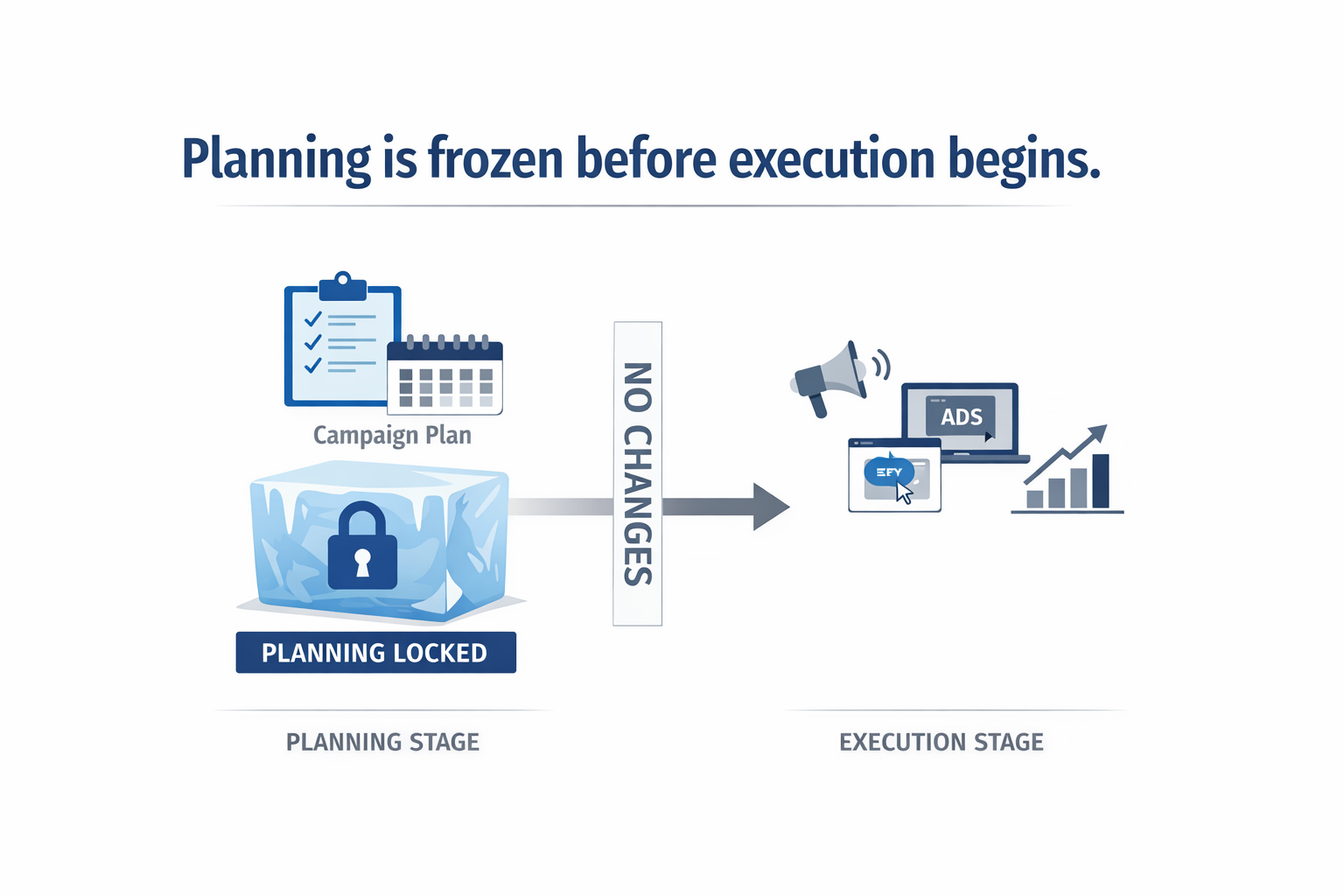
There’s no frozen reference version,
then the strategy is fragile. It will bend under pressure. And campaigns always experience pressure. Deadlines compress. Competitors move. Leadership intervenes. Performance fluctuates. Without discipline, every fluctuation triggers reactive budget changes. Reactive systems rarely produce stable outcomes.
What budget discipline actually means
Budget discipline does not mean rigidity. It means:
A clearly approved budget version before execution begins.
Explicit documentation of allocation logic.
Formal approval for reallocation above a defined threshold.
Version tracking when structural changes occur.
Clear separation between “optimization within allocation” and “changing allocation.”
That last distinction is critical. Optimization within allocation: ? Adjusting bids, creatives, targeting. Changing allocation: ? Moving money between channels or phases. Most teams blur the two. They call allocation shifts “optimization.” They’re not the same. One is tactical tuning. The other is strategic redefinition. Strategic changes deserve governance.
Why teams obsess over mix instead
Media mix feels sophisticated. Budget discipline feels procedural. One looks like a strategy. The other looks like control. But experienced operators know that, without control, strategy is theoretical. The most resilient campaigns I’ve seen weren’t the ones with the cleverest allocation models. They were the ones where:
The approved budget was clear.
Changes were deliberate.
Every shift had a decision trail.
Everyone knew which version was live.
That clarity creates calm. And calm teams make better decisions.
A simple thought experiment
Imagine two campaigns:
Campaign A:
Average media mix.
Extremely strong budget discipline.
Version-controlled reallocations.
Clear approval checkpoints.
Campaign B:
Perfectly modeled media mix.
Weak discipline.
Frequent informal shifts.
No version clarity.
Which one is more likely to produce reliable, defensible outcomes? In the short term, either could perform well. Over multiple cycles?
Campaign A will outperform — not necessarily in ROAS every week, but in predictability, learning, and institutional trust. And predictability compounds.
The uncomfortable question
When performance dips, most teams ask: “Should we change the mix?” Very few ask:
“Are we disciplined enough to evaluate this mix properly?” Because if the budget baseline has shifted multiple times, you are no longer evaluating the mix. You’re evaluating a moving target.
Media mix optimization is important. But it sits on top of something deeper. If media mix is the architecture, budget discipline is the foundation. And no one debates paint colors on a building with a cracked foundation. Before optimizing allocation percentages, ask something simpler: Is your budget governed — or just managed? There’s a difference.
← Back to Blog