
March 28, 2026
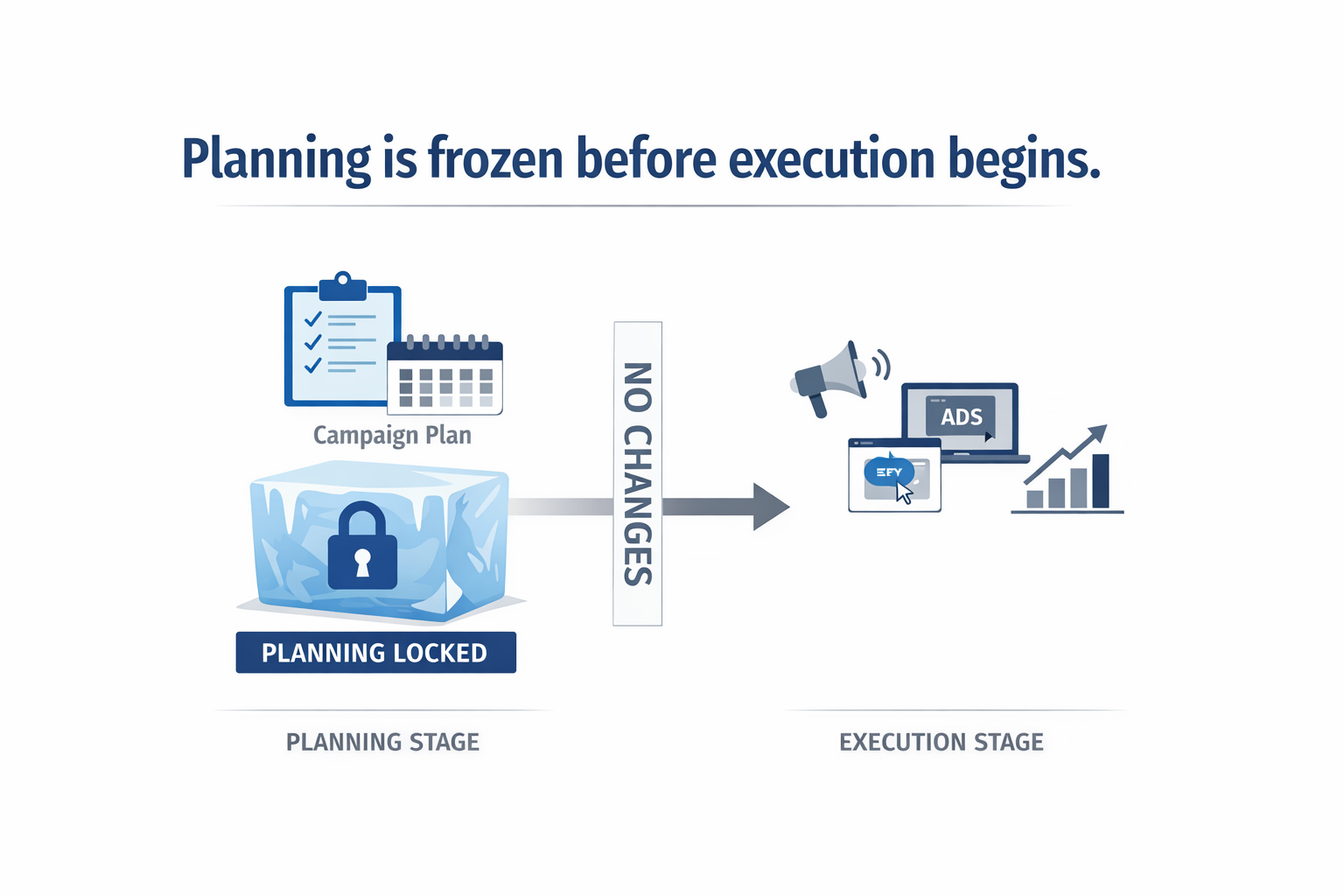
Most campaigns don’t fail during execution. They fail before execution even starts.
Not because teams are incompetent. Not because budgets are too small. Not because tools are missing. They fail because planning never actually ends. And when planning never ends, execution becomes chaos disguised as agility. Let me explain
Today’s campaign workflow looks like this:
On paper, this is called flexibility. In reality, this is structural indecision. And indecision scales very badly.

In most agencies and political campaigns, planning and execution are blurred into one continuous loop. A planner adjusts because execution reports are coming in. Execution teams adjust because planning keeps changing. Leadership intervenes because nothing feels “locked”. So what actually happens?
Everyone is busy. Nobody is sure. Why “execution-first” thinking feels attractive (and why it fails) Execution-first thinking sounds modern:
“Let’s not overthink. Let’s move fast.” “We’ll optimize in real time.” “We’ll adapt based on performance.”
This mindset works only when:
But in high-stakes campaigns — political, national, multi-city, multi-agency, or reputation-sensitive — this approach breaks down. Because execution amplifies planning errors. It does not correct them. Every late correction costs:
By the time you “optimize”, the damage is already embedded.
Planning is not about predicting the future perfectly. Planning is about locking intent.
A good plan does four critical things:
Without this freeze, you are not managing a campaign. You are reacting to one.
This is where most people misunderstand the argument. Freezing planning does NOT mean:
It means:
When planning is frozen:
Without a frozen baseline, you cannot even answer:
“Did this campaign work because of our plan, or despite it?”

When planning stays fluid during execution, risk becomes invisible
Later, when something goes wrong:
This is not just operational risk. This is institutional risk.
An individual can improvise. An agency cannot — at least not safely. Agencies operate with:
For agencies, planning is not a creative exercise. It is a governance function. And governance without freeze is an illusion.
Think about building a bridge. Engineers don’t keep changing the blueprint while construction is ongoing. They:
Adjustments happen — but relative to a frozen reference.Campaigns are no different. They are systems, not experiments.

The discipline we need to bring back We need to bring back a few unfashionable ideas:
Not for bureaucracy. For clarity Not to slow teams down. To stop silent chaos.
If someone asked you today:
“Show me the final, approved version of your last campaign plan — the one execution was based on.”
Could you do it?
Or would you have to reconstruct it from emails, sheets, and memory?
Tools didn’t kill planning discipline. Urgency did. Pressure did. Fear of being “too rigid” did.
But rigidity is not the enemy. Ambiguity is. I’ll leave you with this: Execution should be fast. Planning should be slow, deliberate, and finished. If planning is never frozen, execution is never accountable.